How I Make AI Films
A practical look at the workflow I actually use at Periti Studios, and where the machine stops and the filmmaking begins.
By Alexander Kiesel, film producer, director, and founder of Periti Studios.
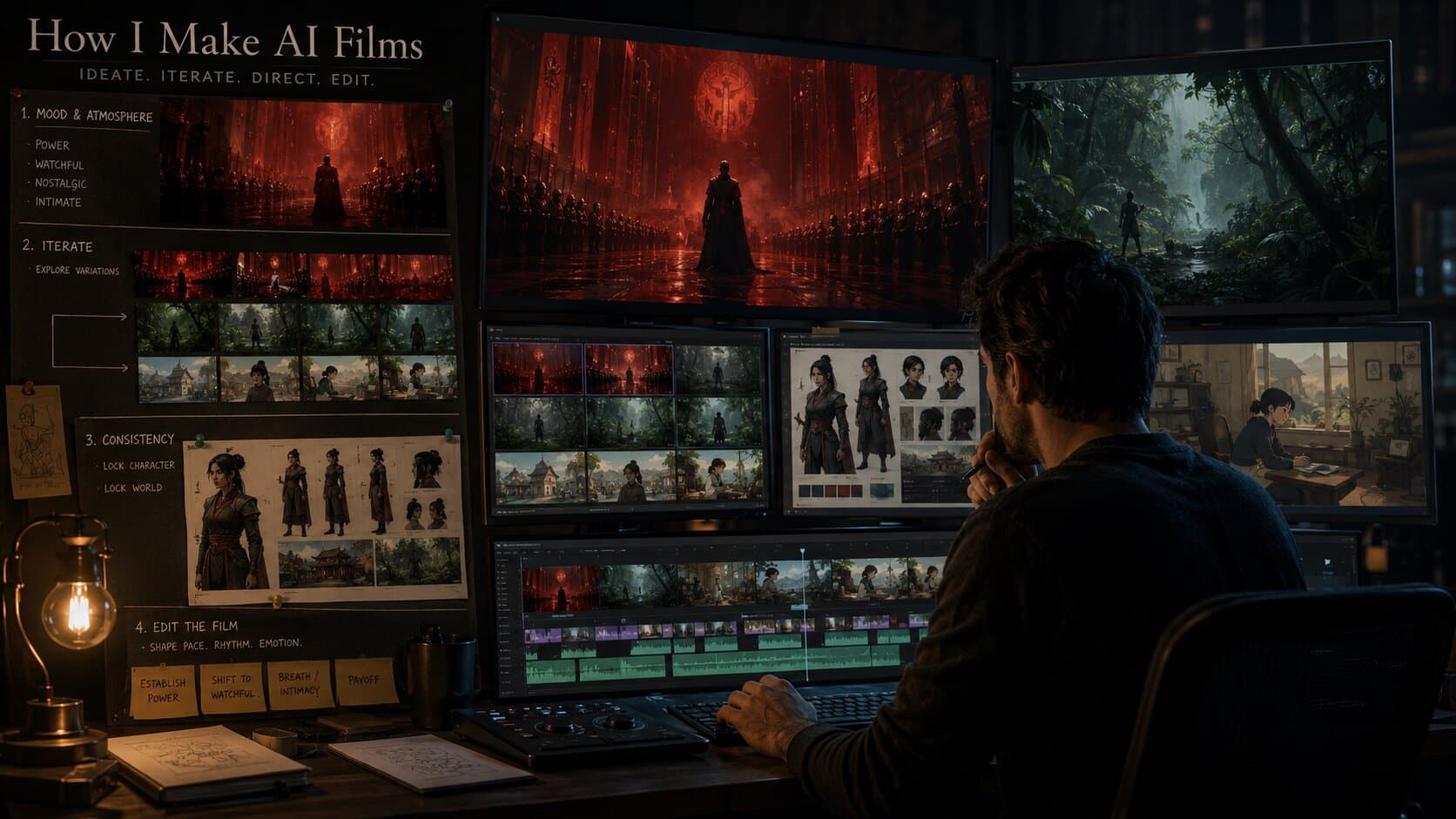
The question I get most often is some version of “can you really make a film with AI?” The honest answer is: you can make a lot of one. The tools are extraordinary at generating image, motion, and atmosphere. What they can't do is decide what is worth making, or know when a shot is finished. That part is still the job, and it's the part I care about most.
I've written before, in Hollywood Is Cooked, about why I think the old barriers around production are collapsing. This piece is the practical companion to that argument: how the work actually gets done, step by step.
1. Start with image and atmosphere, not a script
Most filmmaking advice tells you to start with story. I usually start with a single image and a feeling. Before I know what a project is “about,” I want to know how it looks at 2 a.m. in one frame: the light, the color, the texture of the air. If that frame doesn't hold your eye, no amount of plot will save it.
With Red Empress, the whole world grew out of one idea: imperial power rendered as pure atmosphere. With The Last Amazon, it was humidity and silence, a jungle that feels like it's watching. The script, the beats, the cuts all come later. The mood comes first because the mood is the thing people remember.
2. Generate fast, then throw most of it away
This is where AI changes the math. Traditional production makes iteration expensive: every version costs a shoot day, a location, a crew. AI-assisted tools make iteration nearly free, which means the real skill becomes selectionrather than execution. I generate far more than I need and discard ruthlessly. The difference between an amateur and a director using the same tools is almost entirely what they're willing to cut.
I work in passes. First pass: silhouettes and palettes. Am I in the right world at all? Second pass: lock the character and the key locations so they stay consistent. Third pass: motion and the specific shots I know the edit will need. Each pass narrows the world a little more.
3. Treat prompting as directing
A prompt is not a magic spell; it's a set of directions to a very fast, very literal collaborator. The same instincts that make someone a good director on a set (knowing what to ask for, what to leave alone, when a take is right) are what make the difference with these tools. Consistency of character and place is the hardest part, and it's where most AI work falls apart. Solving it is less about clever wording and more about building a clear visual language and refusing to drift from it.
4. The edit is still where the film is made
No matter how good the generated material is, it arrives as raw footage. The film is made in the edit: rhythm, restraint, the order of images, where the music breathes. I cut the same way I would with conventional footage: protect the feeling, kill the shots that are merely impressive, and let pace do the storytelling. A trailer lives or dies on timing, and timing is not something you can generate.
The same discipline carries over even when the form is completely different. With Still Motion, the lo-fi 2.5D animation series, the tools and the mood are the opposite of a high-impact trailer, but the method is identical: decide on the feeling, then protect it through every choice.
5. What AI doesn't replace
AI doesn't replace taste. It doesn't replace having something to say. It doesn't replace the restraint to make a project smaller and sharper instead of bigger and louder. If anything, because production is now so cheap, those human qualities matter more, not less. They're the only things left that are scarce.
That's the whole thesis behind Periti Studios: a small, independent operation can now make work at a scale that used to require a studio, as long as it keeps a point of view. The tools are democratized. The judgment isn't.
The short version
- Find one image and one feeling worth protecting.
- Generate far more than you need; cut without mercy.
- Direct the tools. Consistency beats cleverness.
- Make the film in the edit, not the generator.
- Spend your taste, not just your compute.
Frequently asked
Can you really make a film with AI?
You can make a lot of a film with AI: images, motion, atmosphere, alternate versions of a scene. But the parts that decide whether it works are still human, like taste, story, pacing, and knowing what to cut. I treat AI as a fast camera and a tireless art department, not as the director.
What does an AI filmmaking workflow actually look like?
Mine starts with image and atmosphere instead of a finished script. I lock the look first (light, color, character, location), then generate and iterate quickly, direct the tools toward a consistent world, and finally edit everything into a trailer or short with conventional editing software. The AI accelerates the middle; the beginning and the end are still craft.
Do you need a big budget or a big team to make AI films?
No. The whole point of how I work at Periti Studios is that a small team with modern tools can reach a scale that used to require a full pipeline. Restraint matters more than budget. A clear point of view beats throwing compute at every shot.
Keep reading